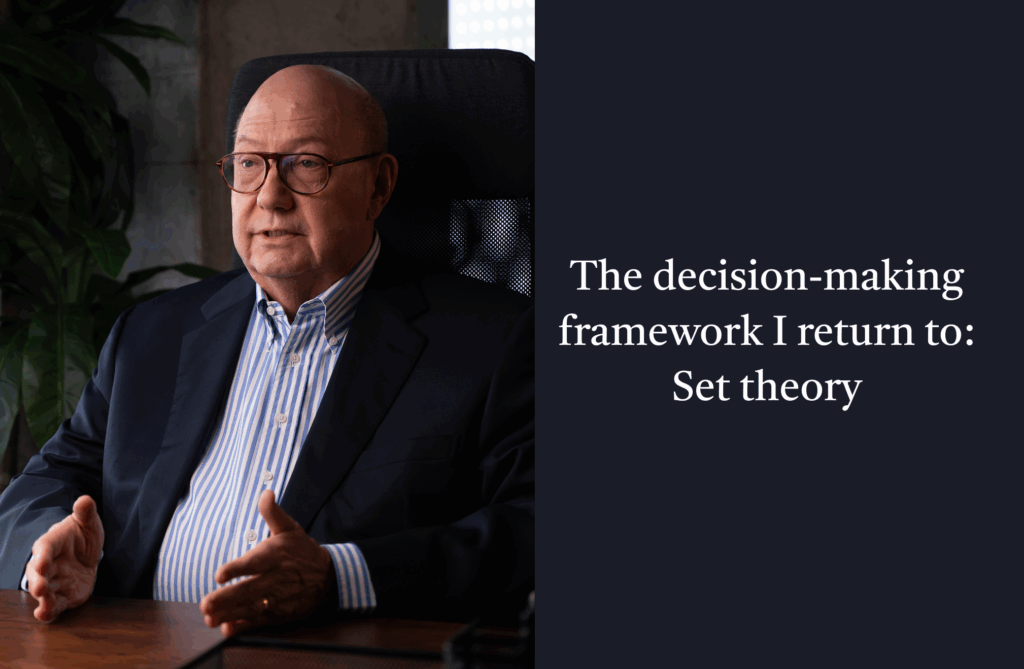
Over the years, I’ve found that many people approach decisions by narrowing their focus too early. They home in on what seems like the most obvious choice, without first exploring the full range of possibilities. It’s understandable. Time is often limited and business tends to reward speed. But I’ve learned that the best outcomes rarely come from rushing to conclusions. Instead, they come from taking the time to understand all the potential outcomes before acting. For me, the framework that best supports that kind of thinking is set theory. While it’s really a branch of mathematics, its value goes far beyond numbers. Set theory forces you to look at the complete picture, every variable, every outcome, every possible intersection.
When that previous work is done thoroughly, the right path often reveals itself with surprising clarity.
The logic of set theory
At its core, set theory is about defining relationships and understanding all the possible elements in a system and how they intersect. In business, those “elements” are potential outcomes. People often make decisions by focusing on only one or two visible options. But every choice sits within a broader network of possibilities, and ignoring that structure can lead to incomplete thinking and therefore subpar results.
By applying set theory to decision-making, you force yourself to map the entire landscape before acting. You see how one path overlaps with another, where risks and opportunities intersect, and which options truly stand apart. Once that picture comes into focus, uncertainty tends to morph into clarity, and the best decision will hopefully reveal itself not through intuition, but through logic.
Investigating every outcome
When it comes to decision-making, the real challenge isn’t about choosing, it’s about seeing. Too often, people rush to define the problem narrowly, focusing only on what’s in front of them. That limited view makes it easy to overlook connections, hidden dependencies, and risks that only emerge when you step back and look at the full picture. The strongest decisions come from that broader vantage point and the willingness to examine the system as a whole before committing to a path.
This approach demands real patience and intellectual stamina. It’s about asking better questions, challenging your own assumptions, and mapping the range of possible outcomes until the logic becomes undeniable. You might be investing, innovating, or leading, but in all cases, clarity comes from exploring widely, not reacting quickly. Once you’ve done that work, the next step is rarely a leap of faith, which is the natural conclusion of disciplined thought.
The clarity of a well-defined set
When you take the time to map every possible outcome, uncertainty begins to organize itself. What once felt complex becomes structured; patterns start to emerge. It’s not that the decision suddenly becomes easy; it’s that it becomes logical. You’ve built a structure that reveals what makes sense and what doesn’t. That’s the value of applying set theory to decision-making. It’s a disciplined way of seeing the full picture before you act.
Once the set is defined, once every variable and outcome is understood, uncertainty loses its power. You no longer rely on instinct or emotion alone; you rely on the logic of the system. In my experience, that’s when the best decisions emerge. When you see the whole set clearly, the right choice isn’t a matter of luck or intuition; it’s simply the inevitable conclusion of clear thinking.
You can find more of my reflections on entrepreneurship, business and other passions of mine on my YouTube and social media channels.