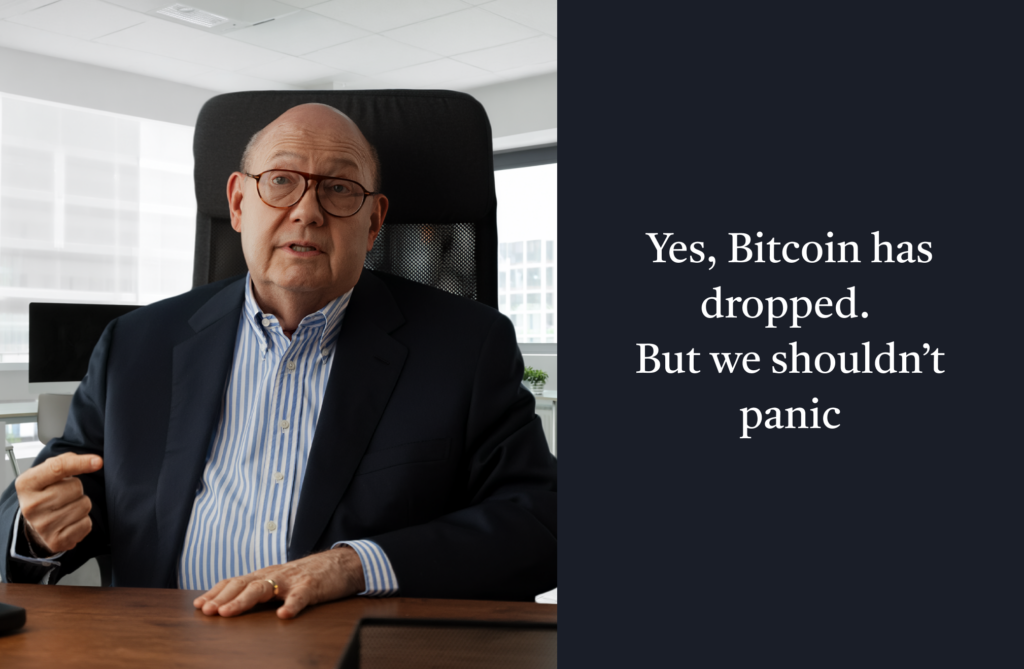
Bitcoin’s value has dropped. That much is obvious. What’s not so obvious is where its value might go from here. But if you’ve been around the crypto market for any length of time, you’ll know volatility is part of the game. Maybe it’s even the reason you came into the crypto space in the first place. In that regard, the crypto market is synonymous with uncertainty. I’ve been faced with countless situations of uncertainty over the course of my career, and I’ve learned that the first thing we should do when faced with such a situation, is take a step back and observe. Patience is key. Whether it’s business, sport, or crypto, the same rules apply.
Uncertainty, volatility? Nothing new for Bitcoin
When we look at Bitcoin over its whole lifecycle, the current pullback seems much less dramatic than it might at a first glance. Since its launch, Bitcoin has been on a rollercoaster journey, with sudden surges followed by just as sudden dips. Back in 2013, it surged and then retraced. Back in 2017, it shot up to $20,000 before dropping back down. The 2020-2021 cycle saw big institutional participation and new highs, but then a big drop in 2022. At the time, each of these moments felt like either the start of something amazing or the end of something that wouldn’t last. But when taken as a whole, they were simply chapters in a much bigger story.
What’s important to note is not the volatility itself, but the patterns that it draws out in the background. Each cycle has established higher long-term support levels than the one before. That doesn’t mean that prices have only moved in one direction, and it certainly doesn’t remove risk, or uncertainty. But it does reinforce a structural truth about Bitcoin, that both volatility and uncertainty has always accompanied growth. Expecting smooth, linear appreciation from an asset that is still relatively young just isn’t realistic. Corrections are part and parcel of the maturation process, and not a sign that something is broken.
What are others saying?
In the face of uncertainty, it’s also important to listen to outside opinion. It helps gain perspective and frame the situation at hand alongside other factors, markets, players, or industries you may not have considered. If we do that with Bitcoin, forecasts are not at all pessimistic. Carol Alexander at the University of Sussex expects a high-volatility range between $75,000 and $150,000, with a center of gravity around $110,000. Standard Chartered has revised its earlier $300,000 projection down to $150,000, and CoinShares is targeting a range between $120,000 and $170,000, with expectations of stronger performance in the second half of the year.
The underlying common thread is what is truly intriguing here, not the variation itself. The range is wide because the asset is volatile by nature, that’s a given. What we should be focusing on is how the lower bounds being discussed are still materially above prior cycle floors. This is key! Managing and adjusting your forecast doesn’t have to mean losing conviction or selling out on your original plan. It’s about paying attention to how the situation is evolving, factoring in information that you may not have had at the outset, and recalibrating your plan as things pan out. Overall, this should reinforce perspective, instead of replacing it.
Volatility isn’t unique to crypto…
Volatility, like uncertainty, is not unique to crypto. It is a part of most aspects of life, particularly business. Over the course of my career, I’ve been able to observe markets undergoing unanticipated shifts, industries transitioning faster than expected, and assumptions that initially seemed sound requiring recalibration. And when it comes to setting up your own business or project, growth is invariably accompanied by setbacks. Volatility is the rule, not the exception, and it’s an essential part of learning how to operate in environments where innovation is the engine of progress.
The question is then how we respond to uncertainty. In entrepreneurship, as in crypto, we can’t react emotionally to every change, every fluctuation, every spook. It’s important to assess whether something fundamental has changed, to look at structure and not focus on the noise. The same discipline applies to crypto. If short-term swings create anxiety, then frankly, crypto probably isn’t for you. But if you understand that volatility is the price of participation in a high-growth environment, then patience is your advantage. The uncertainty won’t disappear, but it will be easier to manage.
Find more reflections on entrepreneurship, business, crypto, and other passions of mine on my YouTube and social media channels.