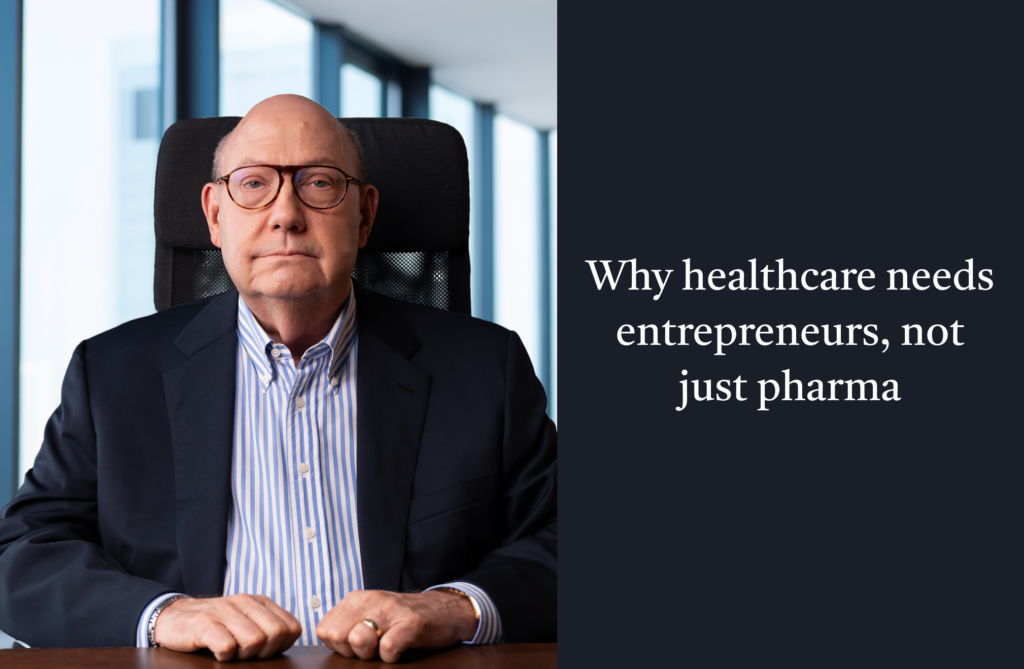
When we think of healthcare innovation, we often think of pharmaceutical breakthroughs. New drugs, new therapies and headline-making clinical trials all play an essential role in improving patient outcomes. But getting down to the bare bones of the healthcare system (pun intended) we see it’s about much more than prescriptions. It’s a vast and intricate system involving patients, providers, technologies, infrastructure and costs. Often, improvements in the healthcare sector often come when people start asking questions. Big pharma does extraordinary work, but their focus is naturally centered on drug discovery and regulatory approval. Entrepreneurs tend to look at the system from another angle to identify bottlenecks, inefficiencies, and long-standing assumptions that may no longer hold true.
As in business, rethinking how some problems are approached and solved can bring enormous benefits.
Healthcare is first and foremost, a system
Pharmaceutical companies play a vital role in the healthcare sector. Their work in developing new medicines, running clinical trials and navigating regulatory approval has saved countless lives and continues to advance medical science. However, when viewed in its entirety, the healthcare system reveals that medicine alone is not a panacea. A wide range of factors influence healthcare outcomes, including the manner in which care is delivered, the approach to diagnosis, the design of systems, and the efficiency with which treatments reach patients.
Entrepreneurial thinking can change how systems work. This is where entrepreneurial thinking becomes a key factor. Entrepreneurs often adopt a unique approach to healthcare challenges. Rather than focusing exclusively on developing new drugs, they examine the broader system and identify the most acute pain points. In some cases, the opportunity lies in improving diagnostics. In other cases, it involves designing better digital health tools, or rethinking how treatment is delivered.
Entrepreneurs tend to see the problem differently
Entrepreneurs tend to approach healthcare challenges with a different mindset. Large institutions often have to manage complexity, regulation, and scale, which can make it difficult to focus in on a single problem. By contrast, entrepreneurs typically initiate their ventures by pinpointing a single issue that has a disproportionate impact, and then focus all their efforts on finding a solution to it. This level of focus can lead to beneficial innovations, especially in areas where the current system has been unable to make headway.
For example, kidney disease represents one of the most significant medical and economic challenges in the United States, accounting for a substantial share of healthcare spending and affecting millions of patients. Instead of trying to address multiple conditions at once, our company, Roivios, is focused exclusively on restoring kidney function. Our research explores how pressure imbalances within the kidney can disrupt filtration, and how addressing those underlying mechanics may help restore natural function.
Early clinical studies, including work associated with the GRADIENT study, suggest that reducing venous pressure in the kidneys could improve filtration, particularly in patients with complications related to heart failure. In theory, it’s a simple idea. When the downstream pressure is reduced, the kidney’s natural filtration system has a better chance of functioning the way it was designed to. While the research is still ongoing, it’s an example of the kind of targeted thinking that entrepreneurial minds can offer the healthcare field.
The future of healthcare needs to be collaborative
The evolution of the healthcare field has shown that progress is never the product of just one type of institution. Pharmaceutical companies, academic researchers, biologists, healthcare providers and entrepreneurs all approach problems from different angles. That diversity of perspective is the source of some of its greatest breakthroughs. Large organizations bring scale, resources, and regulatory expertise, while entrepreneurs bring focus, speed, and a willingness to challenge long-standing assumptions.
As healthcare continues to progress, the greatest advances are likely to appear where these fields meet. Entrepreneurs can spot problems that others have missed. Larger organizations can provide the infrastructure, clinical expertise, and reach needed to scale those solutions once they prove effective. When these forces work together, innovation can be spectacular. Healthcare is too complicated a field for any single player to solve on their own, which is exactly why the system works best when we open the doors to collaboration.
Find more reflections on entrepreneurship, business, crypto, AI, and other interests of mine on my YouTube and social media channels.