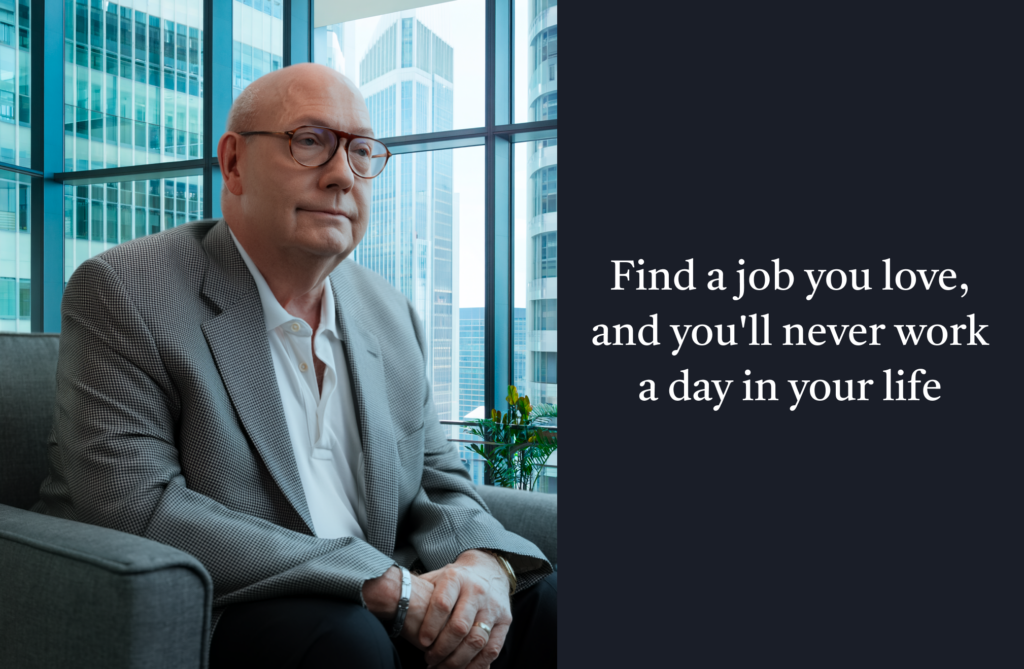
A common saying in business circles is “Find a job you love, and you’ll never work a day in your life.” It’s often attributed to Warren Buffett, though it actually dates back centuries to Confucius. Despite its age, the quote still resonates, because at some level, most people have felt it. That feeling when you’re so connected to a job or task, that you get lost in it; it feels like a hobby more than something you’re obliged to do.
But enjoying your work doesn’t necessarily mean it comes easy. Most worthwhile endeavors require huge investments in time and effort, pressure, and long periods of focus. The distinction lies not in the absence of difficulty, but in how you engage with it. When the work itself is interesting to you and aligns with your natural way of thinking or your curiosities, it holds your attention. You’re less focused on the passage of time and more focused on the problem at hand.
Why is Warren Buffet so well-aligned with this quote?
Buffett is known for his long-term thinking. He doesn’t chase trends or react to short-term noise; he has built his success on patience and discipline over decades. This level of consistency is difficult to maintain without a genuine interest in what you’re doing. It’s impossible to think in 10-, 20-, or 30-year time horizons if your primary focus is simply getting through the next quarter.
He’s also someone who has stayed remarkably close to what he enjoys. If you listen to him speak, or read his shareholder letters, there’s a clear sense that he finds the process itself engaging, analyzing businesses, understanding markets and thinking through decisions. This is where the connection to the quote begins to gain meaning.
It’s less about the idea that work becomes effortless, and more about the idea that when you’re deeply interested in something, you’re willing to stay with it longer than most people. You read more, think more, and revisit problems from different angles, not because you have to, but because you want to. It’s about putting yourself in a position where you can sustain attention, curiosity, and discipline over a long period of time. Because in most fields, that’s where the real advantage comes from.
Learned skills vs. genuine engagement
One of the things I’ve noticed over time is that many careers are built around learned responses. You acquire a skill, you apply it repeatedly, and over time you become efficient at it. But there’s a difference between being trained to do something and being genuinely interested in it.
Most people make career decisions based on practical considerations, such as education choices, stability and income potential. Those are all valid factors. The issue is that they don’t necessarily tell you whether the work itself will hold your attention over the long term.
In many cases, the people who make the biggest impact in their fields are not just the most technically skilled. They’re the ones who are engaged enough to challenge what already exists, to look at it from a different angle, which sometimes leads to a better solution. Warren Buffet is one example, Elon Musk is another. But, of course, it takes more than passion, and above all, years of dedication to the same set of problems.
Why does this matter now more than ever?
A large portion of modern work is built around applying learned knowledge. It’s how entire professions have been structured, from law and accounting to engineering and medicine. But this is exactly the type of work that is becoming easier to automate. When it comes to learned responses, artificial intelligence is designed to process information in the same way, only faster, more consistently, and at a lower cost than a human.
However, if you’re engaged enough in what you’re doing to challenge how things are done, to understand the system so completely you can see every moving part, you’re operating in a very different category. This is the realm where creativity can flow. Not only can you see all moving parts, you can see how they might fit together in a new way, a more efficient way. You can take that idea and apply it to a system from another industry, finding novel ways to innovate.
If you find a job you love, you’ll never work a day in your life, but you’ll also increase the likelihood that you’ll stay in that job long enough to understand it in whole, not just in part. In a world where more work can be replicated, and more of us can be replaced, this may end up being one of the most important quotes out there.
Find more reflections on real estate, business, AI, and other interests of mine on my YouTube and social media channels.