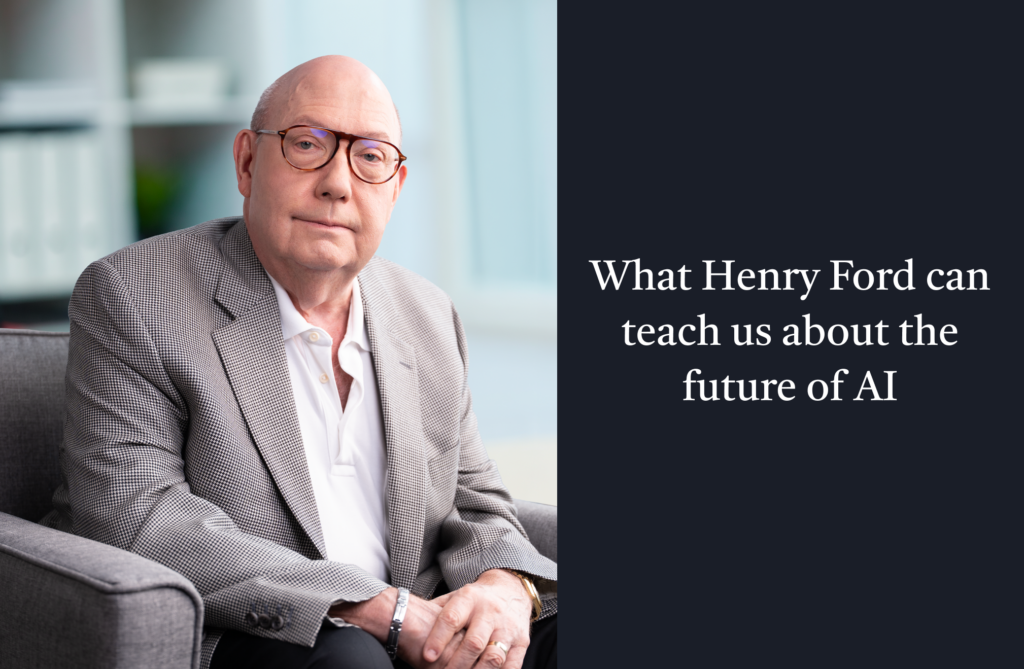
I recently read a McKinsey analysis that draws a provocative parallel between the rise of artificial intelligence and Henry Ford’s assembly line. It presents an interesting comparison that pivots the narrative away from the mechanics of technology and toward the architecture of systems. As the article recounts, Ford’s breakthrough was not just about making a better machine; it was about instilling a better way of organizing work. The assembly line transformed how people, materials and information moved through a factory, changing the economics of manufacturing in the process. We may be approaching a similar point with AI. While much of our focus remains on incremental productivity gains, summarising reports and streamlining routine chores, these are essentially the mechanics. Useful? Yes. But the opportunity for real gains, much like Ford’s assembly line, likely lies in how, and how fast, knowledge moves throughout an organization. In this case, the real impact is on structure.
This is then a perspective on systems. Not unlike my experience, the most transformative breakthroughs rarely come from fine tuning a single component, but from rethinking the entire system.
Improving the system, not the task
When Henry Ford introduced the moving assembly line in 1913, the impact was dramatic. The time required to build a Model T fell from more than 12 hours to roughly 90 minutes. Costs declined, production surged, and automobiles became accessible to a much larger segment of society. The gains were extraordinary, but they did not come from asking workers to tighten bolts faster or work longer hours. Ford reorganized the entire production process around flow.
Much of today’s AI adoption is focused on individual tasks, including drafting reports, summarizing information, generating code, answering questions and creating presentations. These applications are hugely valuable, but improving individual tasks is not the same as improving the system. One thing I’ve found over the course of my career, whether at System73, Accelitron, or in evaluating complex decisions, is that the greatest gains come from identifying bottlenecks and redesigning how information, resources, and decisions flow through the entire organization. AI now offers a similar opportunity.
Knowledge has become abundant
As AI changes how knowledge moves through an organization, it also changes the value of expertise. For decades, companies have relied on specialists to gather information, analyze it and apply it to specific problems. That knowledge often sat in departments, reports, models, meetings or individual experience. AI can now perform many of those functions at extraordinary speed, making knowledge more accessible across the organization.
As knowledge becomes more abundant, judgment becomes more important. AI can identify patterns and generate recommendations, but it cannot determine what a company stands for, which risks are worth taking, challenge assumptions or raise a hand when the obvious answer might be the wrong one. Those decisions still require human perspective. The organizations that benefit most from AI may not be those with the best technology, but those that combine machine intelligence with strong human judgment.
A new operating model for knowledge work
One of the more interesting arguments in the McKinsey article is that AI should not be viewed as a tool,but as a fundamental component of a new operating model. Just as the assembly line revolutionized manufacturing by decomposing production into a fluid, interconnected sequence, AI is poised to evolve knowledge work. Research, analysis, forecasting and planning can increasingly be performed simultaneously, with information moving between specialized systems far more quickly than it moves between departments.
This requires a different way of thinking about organizations. The organizations poised for the greatest advantage are not those merely automating existing chores, but those willing to redesign the very architecture of how information flows and decisions are reached. Henry Ford didn’t set out to refine the horse-drawn carriage; he engineered a system for a new era. AI offers us a similar threshold: the chance not just to polish the old model, but to construct an entirely new one.
Find more reflections on entrepreneurship, business, AI and other interests of mine on my YouTube and social media channels.